



Why Risk Maturity Is a Leadership Problem — Not a Framework Problem
How leadership behaviour determines whether governance frameworks actually work
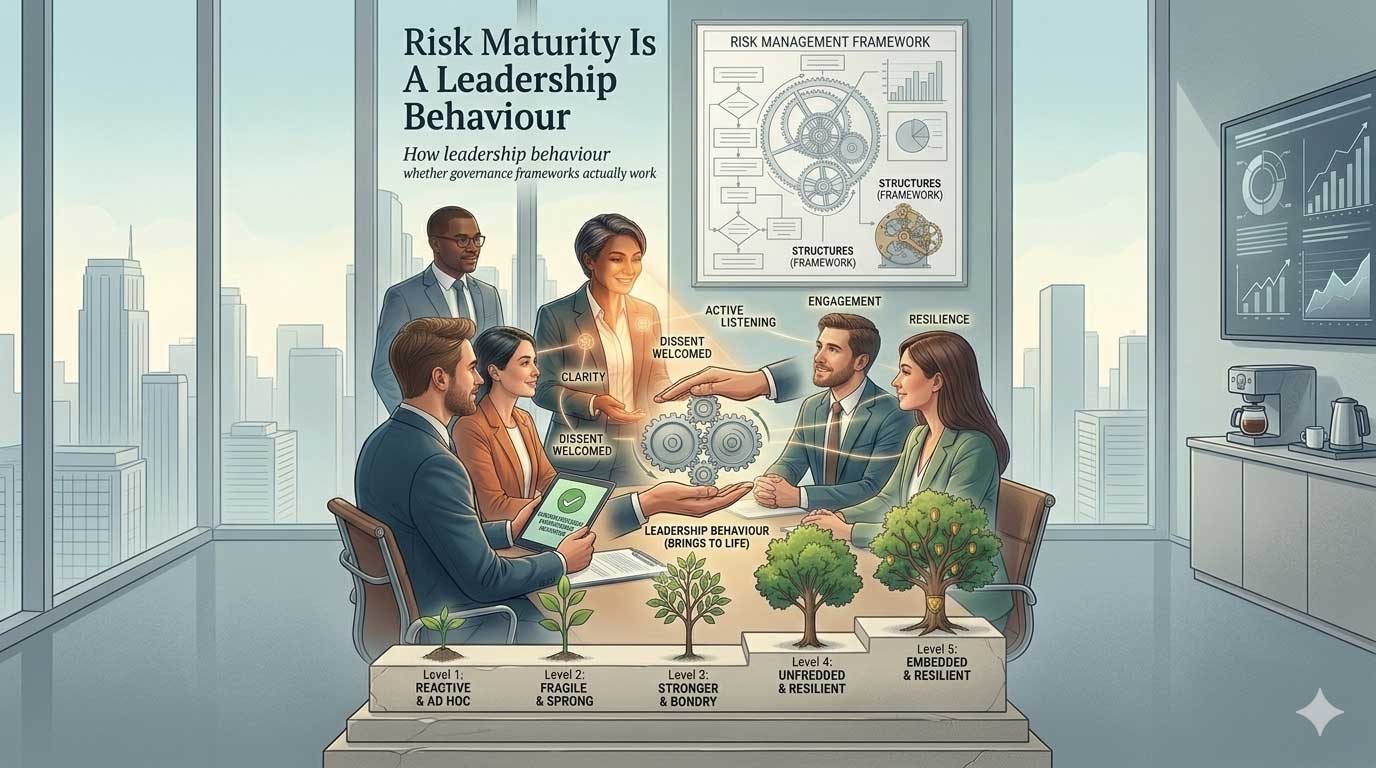
Across industries, organisations have invested heavily in governance structures, risk frameworks, and control systems. Policies have multiplied, reporting dashboards have grown more sophisticated, and assurance mechanisms have become increasingly robust.
Yet when major risk failures occur, they rarely happen because frameworks are missing.
They happen because leadership behaviour overrides the framework at the moment of decision.
This is where many organisations encounter an uncomfortable truth: risk maturity is not primarily a framework problem — it is a leadership problem.
Frameworks and controls provide structure. They define expectations, processes, and safeguards. But frameworks alone do not determine how risks are surfaced, debated, or ultimately acted upon. Those outcomes are shaped by leadership behaviour.
“Frameworks provide structure, but leadership behaviour brings them to life.”
At the moment of decision, subtle signals from leaders influence how people engage with risk. Do leaders encourage challenge, or do meetings quietly reward agreement? Is escalation welcomed, or does it carry the unspoken risk of being perceived as slowing progress? Do leaders balance governance with trust, or do they rely on increasing layers of control when uncertainty rises?
These signals shape organisational behaviour far more powerfully than formal policy documents.
In many organisations, risk maturity stalls not because people lack competence or frameworks are poorly designed. Instead, it stalls because the human dynamics around risk remain unexamined. Fear of being wrong, fear of reputational damage, or fear of slowing momentum can suppress the very conversations that strong governance is intended to enable.
The challenge for leaders, therefore, is not simply to strengthen frameworks, but to cultivate the conditions in which those frameworks can function as intended.
This requires leaders to create psychological safety without diluting accountability. It requires openness to dissent, clarity in decision rights, and a willingness to engage constructively with uncomfortable information. Above all, it requires leaders to examine their own relationship with uncertainty — because how leaders experience risk inevitably shapes how their organisations respond to it.
This leadership dimension is becoming increasingly important in fast-growing and rapidly evolving markets such as the GCC. As organisations scale and complexity increases, governance systems must evolve beyond structural compliance toward behavioural maturity.
The future of GRC will not be defined solely by stronger regulations or more advanced technologies. It will be defined by the quality of leadership judgement.
Risk maturity does not live in frameworks. It lives in leadership behaviour at the moment of decision.
Organisations that invest in strengthening leadership behaviour — courage, ownership, and clarity at the moment of decision — will find that their frameworks begin to work as intended.
Because in the end, risk does not live in policies or dashboards.
Risk lives in decisions. And decisions are human.
About the Author:

Nik Sunita Azura Ab Rahim
Founder & Principal, The Liminal Code (TLC), Malaysia
Nik Sunita Azura Ab Rahim
Founder & Principal, The Liminal Code (TLC), Malaysia
Nik is a leadership, risk and culture practitioner with 28 years of experience across the Oil & Gas and Energy industry. An Accounting and Finance professional by background, she spent her first 10 years in the marketing & trading environment managing various trading portfolios from oil, biomass to general commodities. The past 17 years of her career was dedicated to organisational change and transformation work including culture change, risk maturity & intelligence and business improvements transformation. She has led large-scale culture and transformation initiatives including risk culture and maturity assessments across multiple sectors, re-branding of a newly listed company, strategic repositioning of corporate functions, and upstream strategy re‑imagining for an energy organisation.
Driven by her passion for change and transformation, Nik is a certified Ontological and Solutions-Focused coach with 16 years of coaching experience. She has clocked in more than 1000 hours and has coached up to 400 Executives which includes C-Suite and senior to middle management locally and internationallly. She is also a trained facilitator, and moderator with an unwavering belief in collaboration, high creativity, and performance, committed to being a lifelong learner.
She strives to be a catalyst for positive change, supporting individuals and organisations in achieving their goals and realising their fullest potential. Through her expertise as an ontological coach, she empowers her clients to deepen their self-awareness, unlock new perspectives, and embrace personal and organisational growth.
Nik is also the Founder and Principal of The Liminal Code — a leadership and culture transformation practice that works at the intersection between strategy, risk, leadership behaviour and organisational culture. The Liminal Code focuses on helping leaders navigate periods of transition and uncertainty, strengthening judgement, accountability and courage at moments where decisions matter most. Through this work, Nik partners with organisations to translate intent into behaviour, and culture into measurable maturity.
